

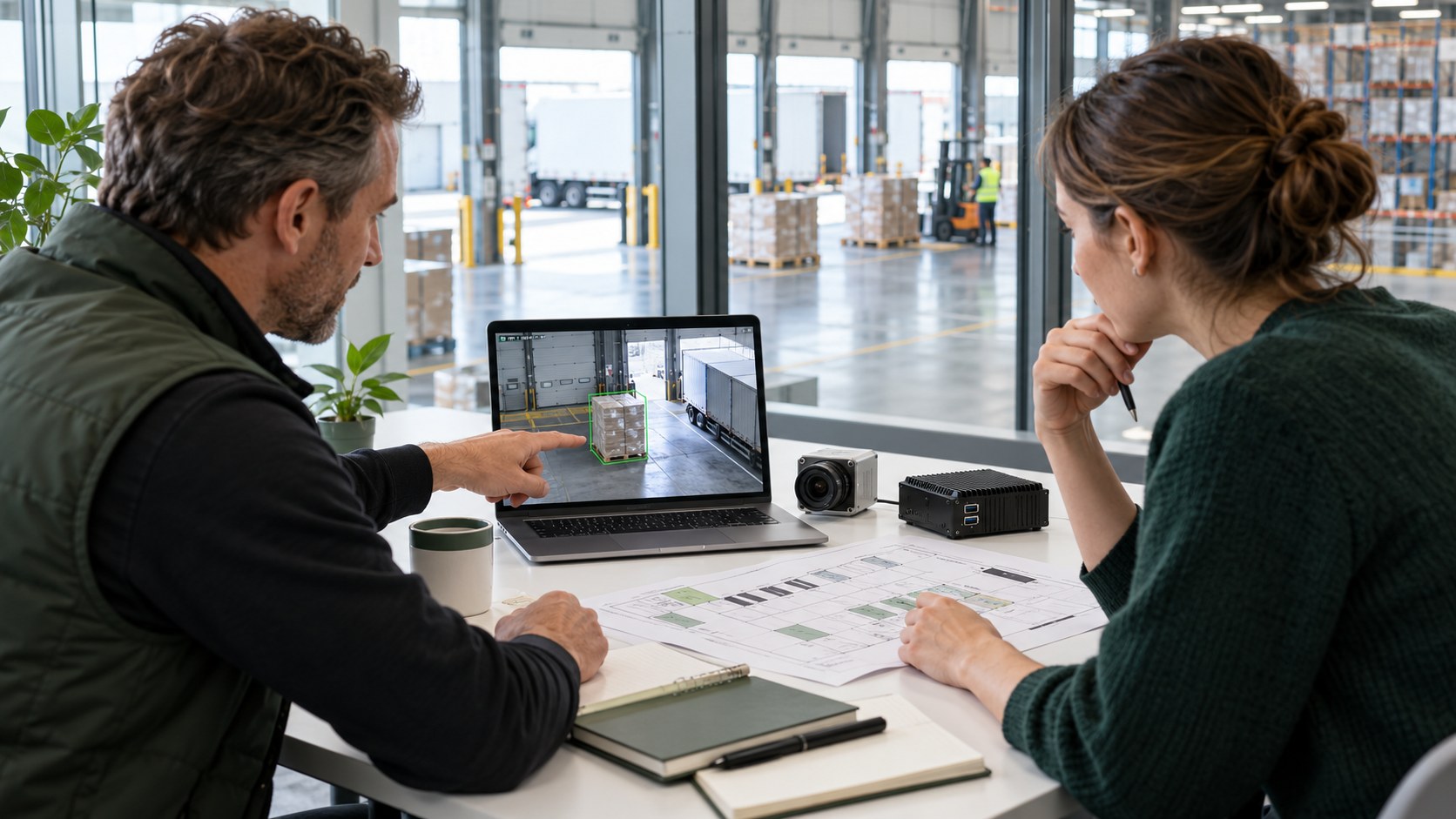
Start with a Clear Operational Goal
A Visual AI project starts by defining an observable problem and the decision that better information should support. That might mean checking whether a loading bay is occupied, reading a shipment reference or flagging a specified visible anomaly for review.
Moving from an idea to a useful computer vision pilot requires more than selecting a model. Cameras, representative data, event definitions, integrations and the people responding to the results all influence the outcome.
This guide sets out a practical way to scope the first use case, agree what success means and gather evidence before deciding on wider deployment.
In this article
Define the First Use Case
Begin with a recurring operational problem and a process owner who can explain how it is handled today. Write down what the camera must observe, where the observation is needed and what someone should do with the result.
For example, a limited requirement could be: observe occupancy at one named loading bay, record changes and send candidate extended-occupation events to a coordinator. Confirming that loading is complete or deciding which shipment has priority would require additional business context.
- Define the target: name the object, field, condition or event to be assessed.
- Set the boundary: identify the area, operating periods and situations included in the first evaluation.
- Name the response: specify the reviewer, action and required timing.
- Confirm relevance: explain which delay, repeated check, error or information gap the project is intended to address.
Our article on Visual AI in supply chain management provides examples of linking physical observations to operational decisions.
Set Success Criteria and a Baseline
Record the current process before introducing the pilot. Depending on the use case, a baseline could include the time spent checking a bay, the effort needed to enter a reference or the number of exceptions requiring investigation.
Agree both technical and operational measures:
- Output quality: correct detections or complete field reads, false alerts and missed events, compared with reviewed reference observations.
- Timing: the delay between capture and a result becoming available to the person or system that needs it.
- Review effort: how often someone must verify, correct or dismiss a result.
- Process value: whether the information helps the intended decision, measured against the baseline under comparable conditions.
Set acceptance criteria with the process owner. The cost of a false alert can differ from the cost of a missed event, so one overall accuracy figure may hide an important weakness.
The voluntary NIST AI Risk Management Framework emphasises documented evaluation and performance assessment in conditions similar to deployment. For a pilot, this supports agreeing the test conditions and evidence needed before judging the result.
Prepare Representative Images and Video
Collect material that reflects the environment in which the system will be used. A few clear demonstration images can help discuss feasibility, but evaluating a working process needs ordinary activity and the difficult cases that occur on site.
- Operating variation: include relevant shifts, lighting conditions, viewpoints, object types and scene layouts.
- Positive and negative cases: include the event of interest and similar activity that should not trigger it.
- Difficult observations: record occlusion, reflections, motion blur, damaged markings or other task-specific limitations.
- Reference decisions: agree how a reviewer labels an event or confirms a field, and how ambiguous cases are handled.
Keep the material used to tune the system separate from the final evaluation sample. Document where and when each sample was captured so that results can be interpreted in context.
For text-based tasks, our guide to OCR in logistics explains why locating text, recognising characters and validating a business reference are separate parts of the workflow.
Check Cameras and Deployment Requirements
Assess the camera view for the selected task. Resolution alone does not establish suitability: the target must appear at a usable size and angle, with adequate focus, lighting and timing. Confirm access to the video stream and assess compatibility with the proposed processing setup.
Then define where analysis should run and how results should travel. Local computing, cloud services or a combination may be appropriate, depending on response requirements, connectivity, data handling and how the installation will be supported. Our article on why Edge AI matters explains the role of processing near the camera.
Include permissions, access controls, processing location and retention in the project brief. Bring the responsible IT and data-protection teams into the assessment. For related service considerations, read about German-hosted AI, data protection and control.
Plan the Response and Integration
Decide what happens after the system produces a result. A project may need a reviewed event log, a supervisor notification or an update to a business system. Each requires an agreed owner, interface and handling of exceptions.
- Uncertain results: define when an observation goes to a reviewer and what evidence is available.
- System updates: agree identifiers, destination fields, duplicate handling and confirmation that an update was accepted.
- Unavailable components: define how camera loss, stale observations or failed transfers are reported and handled.
- Operational ownership: name who acknowledges events, corrects records and follows up on recurring issues.
Test this response as part of the pilot. A correctly detected event has limited value if it reaches the wrong person or cannot be connected to the relevant record. For safety-related scenarios, our article on AI for warehouse safety discusses the distinction between detections, warnings and established protective measures.
Run the Pilot and Review the Evidence
Agree the milestones and what each must demonstrate. For planning purposes, distinguish:
- Proof of concept: an initial assessment of whether the defined recognition task appears feasible on selected material.
- Pilot: a limited operational evaluation of the agreed capture, analysis and response workflow.
- Production: an operated service with agreed support, monitoring, ownership and change procedures.
Start with a bounded area, a defined task and representative operating periods. Initially, the team can review outputs alongside the existing process, with any connection to operational actions separately agreed. Keep a record of outputs, reviewed outcomes, corrections and failures.
Return to the loading-bay example: compare observed occupancy changes with reviewed footage, measure how long useful events take to reach the coordinator and record whether they help resolve the intended information gap. Include busy periods and ordinary activity that should not generate an exception. This is an illustrative workflow, not a report of a deployed customer project.
Choose Whether to Scale, Refine or Stop
Review the evidence against the acceptance criteria:
- Scale: the tested workflow meets the agreed criteria, the response works and the team has a support and monitoring plan.
- Refine: a specific issue, such as camera coverage, event rules or interface behaviour, can be addressed and retested.
- Stop or change the use case: the relevant event cannot be observed reliably, the response adds insufficient value or the required effort is disproportionate.
Include the full operating cost in the decision: camera adjustments, computing, installation, integration, review time, maintenance and ongoing support. Reviewers should also account for workload or staffing changes when comparing results with the baseline.
A successful pilot establishes evidence for the conditions tested. Plan further validation when adding sites, changing layouts or introducing different objects and operating conditions.
Bring a Practical Brief to airis:net
A useful first discussion with airis:net starts with the operational problem and the result your team needs. Prepare a short brief containing:
- The target event or data field, monitored area and process owner.
- Representative footage or images and details of the camera setup.
- The intended response, receiving systems and relevant interfaces.
- Known constraints involving timing, connectivity, access and data handling.
- The baseline, proposed acceptance criteria and the operating conditions to be tested.
airis:net develops tailored Visual AI solutions for applications across industry, logistics, security and infrastructure. These inputs help scope a project’s feasibility, capture requirements, integration and validation work. Capabilities and performance targets should be agreed for the specific application.
For other applications of the technology, explore airis:ident’s identity verification services and airis:protect’s image and video content analysis.
FAQ
What is a Visual AI project?
A Visual AI project connects image or video analysis to a defined operational task. It includes the camera view, recognition or event rules, data handling, the response workflow and any required integrations, together with validation for the intended environment.
What is the difference between a proof of concept and a pilot?
For project planning, a proof of concept can explore whether a recognition task is technically feasible on selected material. A pilot evaluates the agreed workflow in a limited operational setting. Define what each milestone must demonstrate before work begins.
Can existing cameras be used for a Visual AI pilot?
Possibly. Assess the view, image detail, lighting, frame timing, access to the stream and connectivity for the chosen task. A camera that records an area may still lack the detail or viewing angle required to detect a specific event.
How much image or video data is needed?
There is no universal quantity. The useful sample depends on the event, its variation, how often it occurs and the conditions the pilot must cover. Include ordinary activity, relevant exceptions and difficult cases, with reviewed reference labels for evaluation.
How should a computer vision pilot be evaluated?
Compare outputs with reviewed reference observations under representative conditions. Measure correct detections, false alerts, missed events, response timing, review effort and the operational result. Agree acceptance criteria before testing and document where the system remains unreliable.
How long does a Visual AI pilot take?
Timing depends on data availability, camera suitability, the recognition task, integration work and the operating conditions that must be observed. Agree milestones after scoping these dependencies; a fixed duration alone does not establish whether the pilot has produced enough evidence.
What should a company prepare before contacting airis:net?
Prepare a short description of the operational problem, the target event or data field, representative images or footage, the camera setup, the intended response and any receiving systems. Include known constraints, a process owner and the measures you would use to judge success.