

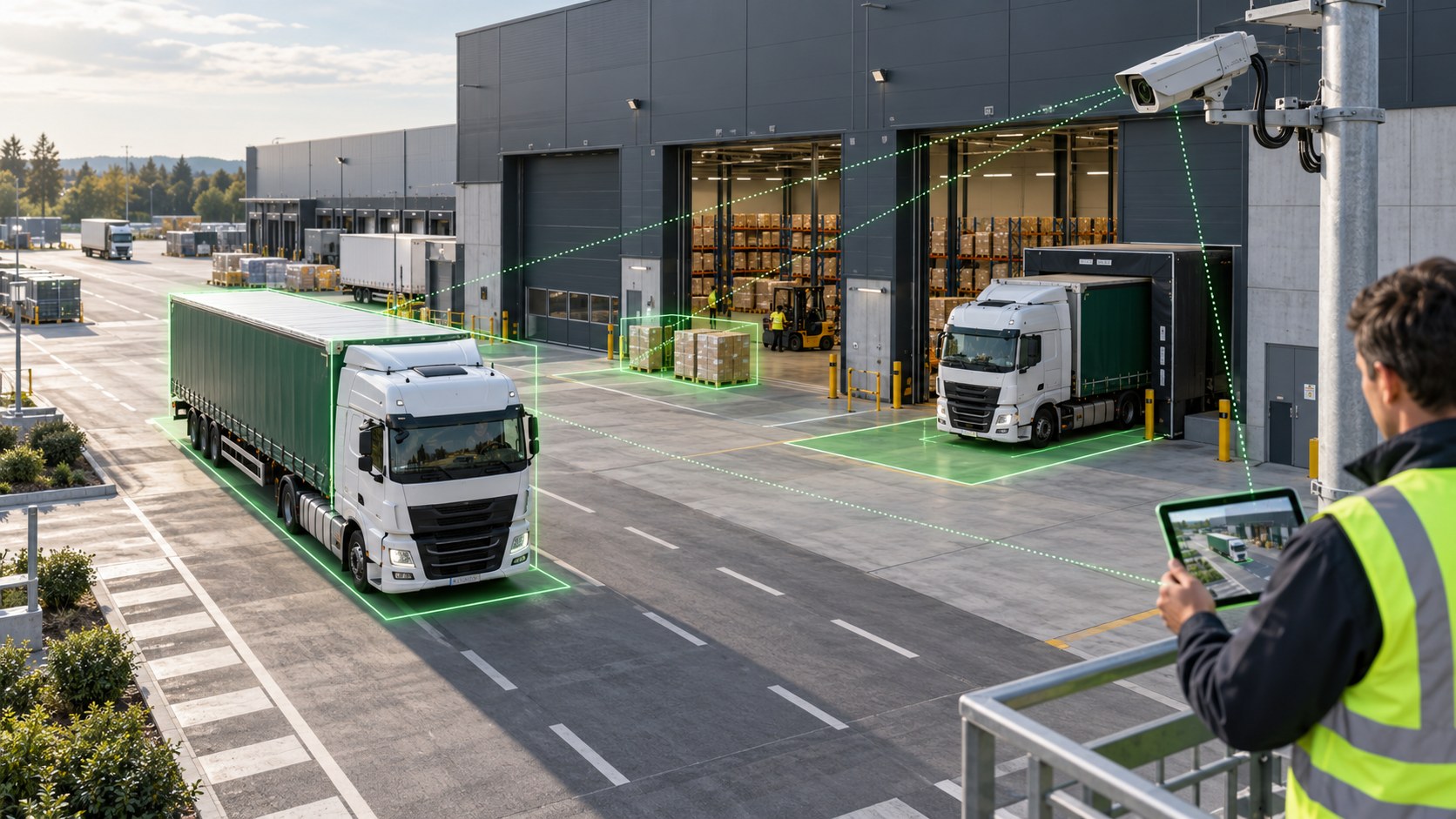
How Visual AI Supports Supply Chain Decisions
Visual AI in supply chain management uses computer vision to turn observations of physical logistics operations into information that teams can check and act on. At selected locations, camera footage can help reveal whether a loading bay is occupied, a staging area is congested or a shipment has a visible condition that needs review.
For supply chain and warehouse managers, the practical value is a clearer connection between what happens on the floor and the decisions recorded in business systems. Useful information needs an operational context: which movement it relates to, when it happened and who should respond.
From Camera Footage to Operational Events
A useful workflow starts with a specific question, such as whether a truck has remained at a bay longer than an agreed threshold. A configured vision system can detect relevant activity, apply event rules and pass a candidate event to a person or an agreed interface.
For each event, define the information needed to make it useful:
- Observation: what was detected, such as a vehicle occupying a defined bay.
- Time and location: when the observation occurred and which area it concerns.
- Business reference: which vehicle, load or shipment it can reliably be associated with.
- Validation and response: which checks apply, who reviews an exception and what happens next.
This creates a traceable path from an observation to an operational decision. Recognition alone cannot establish an order priority, explain every delay or confirm that an activity has been completed correctly.
Three Practical Use Cases
DHL’s report on AI-driven computer vision describes applications in operations, asset monitoring and shipment processing. The following examples show how to frame such applications around a management question; their feasibility must be assessed for the site.
Dock Occupancy and Waiting Times
Management question: where is capacity being held up? A suitable camera view could support events for bay arrival, occupancy and departure. Repeated observations can help a supervisor investigate extended occupation or an apparent mismatch with the loading plan.
Possible decision: check readiness, coordinate the next movement or investigate a recurring bottleneck. Bay occupancy does not establish whether a vehicle is loading, waiting for paperwork or undergoing a check. Those distinctions require additional evidence or business-system data.
Congestion in Transfer and Staging Areas
Management question: where are goods or vehicles accumulating? Defined video zones could help flag sustained occupation of an area or a build-up that exceeds a locally agreed rule.
Possible decision: inspect the area, prioritise a transfer or adjust the release of incoming work. Review repeated events alongside shift patterns, order volumes and layout changes. The observation identifies a condition to investigate; its underlying cause needs operational context.
Visible Conditions at Handover
Management question: does a visible condition need checking before the next handover? Suitable images can document the observable state of a pallet, package or vehicle at an agreed point. A tailored analysis could flag specified visible anomalies for review.
Possible decision: request an inspection, hold a handover or document an exception. Only surfaces visible at sufficient detail can be assessed. External images cannot confirm hidden damage, internal contents or responsibility for a defect.
An Illustrative Arrival-to-Loading Workflow
Consider a truck arriving while its planned bay is still occupied. In this illustrative scenario, the site has suitable camera coverage, an agreed method of identifying the vehicle and access to the relevant arrival and loading records.
- Record the arrival. A validated identifier links the observed vehicle to an expected movement. Uncertain matches go to an operator.
- Check the bay status. A camera observation indicates that the planned bay remains occupied. The scheduling system supplies the appointment and load context.
- Review an exception. If the agreed waiting rule is met, the responsible coordinator receives an event with the location, time and supporting evidence.
- Choose a response. The coordinator checks readiness, access and loading constraints before changing the sequence or assigning another suitable bay.
- Review the outcome. The team compares the event timeline with the operational record to understand the delay and assess whether the intervention helped.
Each step needs a defined owner and a fallback when a camera, matching process or interface is unavailable. The example describes a possible project workflow, rather than a documented customer deployment or an automatic scheduling capability.
Connecting Visual Events to WMS, TMS and ERP
A warehouse management system (WMS), transport management system (TMS) or ERP provides the business context for an observation. Connecting the two requires agreed identifiers, event meanings and interfaces, together with rules for what the receiving system is allowed to change.
Define how the workflow deals with repeated observations, uncertain matches, late events and failed updates. Record whether an event was accepted, corrected or rejected, and make that state visible to the person responsible for the process.
Common event definitions can also help when information crosses organisational boundaries. GS1’s EPCIS standard provides a framework for sharing visibility events about products and assets. Whether an EPCIS-based interface is appropriate depends on the systems and partners involved; camera analysis does not automatically create a standards-compliant integration.
Where identification involves printed references, our article on OCR in logistics explains the capture, recognition and validation steps that can feed the wider workflow.
Installation Requirements and Operational Limits
Begin with a site assessment and representative footage. Existing CCTV may be suitable, but each use case needs its own capture and processing requirements.
- Coverage and image detail: check camera position, lighting, reflections, motion and obstruction by vehicles, racks or loads.
- Event definition: specify the monitored zones, thresholds and start and end conditions. Distinguish a bay occupied by a vehicle from a confirmed loading activity.
- Infrastructure and timing: assess connectivity, computing resources, clock alignment and the full delay between capture and the required response.
- Failure handling: define how unavailable cameras, stale observations and failed interfaces are reported, with an agreed fallback procedure.
- Data handling: agree the purpose, access permissions, processing location and retention for images and event records. Include the responsible operational and data-protection teams.
Camera coverage has boundaries. Goods hidden inside a trailer, activity outside the view and movements between unconnected sites remain gaps. Wider supply chain visibility requires additional records and data sources.
Keep operational monitoring coordinated with established safety procedures. For a closer look at interactions between vehicles and people, read our article on AI for warehouse safety around forklifts and pedestrians.
Measure Decision Quality and Operational Results
Start with one recurring problem, one observable event and a clear response owner. Establish a baseline and acceptance criteria before the pilot, then test representative shifts, traffic levels and operating conditions.
- Event quality: compare detections with reviewed observations, including missed events and false alerts.
- Review effort: measure how many exceptions require attention and how long verification takes.
- Response time: measure the time from an actionable event to acknowledgement and the agreed intervention.
- Waiting and occupation: define each interval explicitly. Gate-to-bay waiting, vehicle time at a bay and confirmed loading duration describe different parts of the process.
- Handover exceptions: assess how promptly visible issues are reviewed and whether the available evidence supports a useful decision.
- Integration reliability: track accepted updates, duplicates, failed transfers and corrected matches.
Compare results under similar operating conditions and account for changes in workload, staffing or layout. A lower alert count alone does not establish an improvement. The operational result should be considered alongside capture, integration, review and support costs.
Scale after the team has demonstrated that the information is dependable enough for its intended use and that the response workflow works in practice. Reassess when cameras, routes or processes change.
Discuss a Supply Chain Project with airis:net
airis:net’s logistics solutions address areas including vehicle and cargo identification, condition monitoring and loading-bay visibility. A useful project starts by selecting the observation and operational decision that matter at your site.
Bring a site plan, representative footage, the event you want to detect, the person who will respond and the systems that need the result. These inputs help define a tailored project’s capture, validation, integration and pilot requirements.
For related considerations, explore German-hosted AI, data protection and control. Other applications of the technology include airis:ident’s identity verification services and airis:protect’s image and video content analysis.
FAQ
What is Visual AI in supply chain management?
It is the use of computer vision to interpret images or video from logistics operations and turn defined observations into information for a business workflow. Examples include dock occupancy, activity in staging areas and visible conditions at a handover. Its value depends on coverage, validation and how the information is used.
Can Visual AI provide visibility across the entire supply chain?
Cameras provide observations at the locations and times they cover. Broader supply chain visibility requires those observations to be linked with identifiers, business records and data from other sites or partners. An unseen movement or hidden item remains a gap.
Can existing CCTV cameras be used?
Possibly. Camera compatibility, image quality, viewing angle, lighting, connectivity and access to the video stream must be assessed. A camera suitable for reviewing an incident may not provide the view or timing needed for a particular operational event.
How does Visual AI connect to WMS, TMS or ERP systems?
A project needs agreed identifiers, event definitions, matching rules and interfaces. It must also handle uncertain observations, duplicate events and rejected updates. Detecting activity in a video does not, by itself, update an operational record.
Does Visual AI automatically reschedule trucks or authorise loading?
No. Detecting occupancy or an anomaly does not establish that a bay is operationally available or that loading is authorised. Any automated action requires separately agreed business rules, integration, permissions and validation. Human review should be defined for exceptions.
Which use case should a company pilot first?
Start with a recurring operational problem, a camera view that can observe the relevant event and a clear response owner. Define a baseline and acceptance criteria, then evaluate missed events, false alerts, review effort, response time and the operational measure the project is intended to improve.