
How AI for Warehouse Safety Supports Your Team
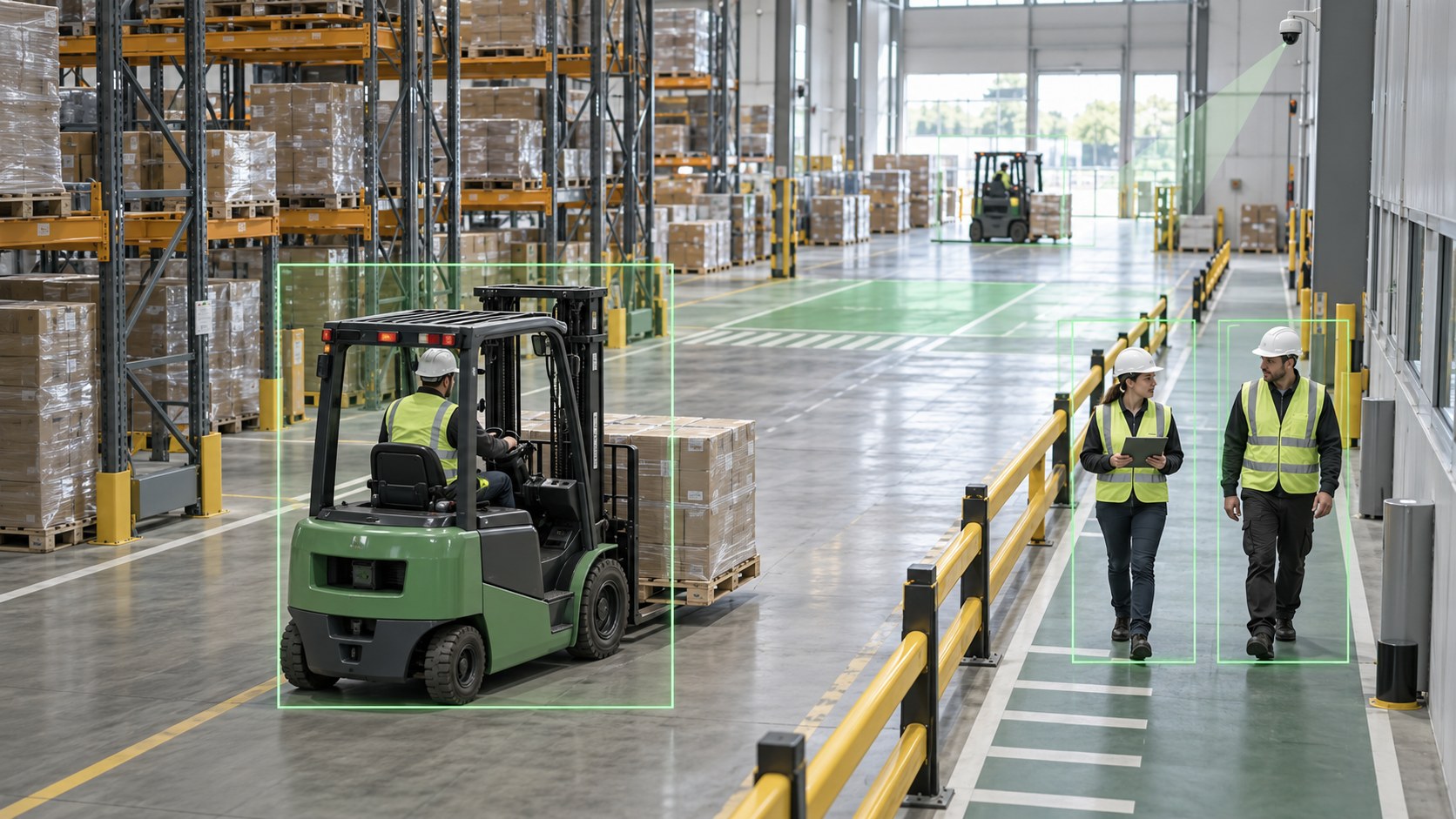
AI for warehouse safety uses computer vision to analyse camera footage and flag defined situations involving forklifts, pedestrians, and traffic routes. With suitable camera coverage and site-specific validation, Visual AI can support warnings and help managers identify recurring risk patterns.
For warehouse, logistics, and safety teams, the useful question is concrete: where do people and moving vehicles interact, and what action should follow when a potentially unsafe situation is detected?
Video analytics complements established controls. The UK Health and Safety Executive’s workplace transport guidance prioritises separating pedestrians and vehicles wherever possible. AI alerts do not replace safe routes, barriers, training, or an effective traffic management plan.
Four situations worth assessing
Crossings between pedestrian and forklift routes
At a marked crossing, a configured system could combine pedestrian detection with vehicle detection to flag simultaneous presence in a defined conflict zone. For example, a pedestrian entering the crossing while a forklift approaches could trigger a warning, subject to the available view and validated rules.
The design must define the monitored area, what counts as an approach, who receives the warning, and what response is expected. An alert arriving after the interaction is useful for review but unsuitable as an immediate warning.
Blind corners and aisle intersections
Racking, stacked goods, and carried loads can hide pedestrians from drivers. A camera positioned to observe both approaches may support detection before a person and a forklift enter the same intersection.
However, a camera cannot detect a person it cannot see. If shelving or loads obscure the view, additional coverage or a different camera position may be needed. Video analysis cannot compensate for an unobserved approach.
Entry into operational zones
A clearly defined video zone could flag pedestrian entry into an active loading or manoeuvring area. A practical example is a worker leaving a packing station and stepping into a forklift turning area.
Detecting a person inside a zone does not establish whether that person is authorised to be there. Any link to work schedules, access rules, or other systems requires a separate technical and operational assessment.
Obstructed pedestrian routes
A pallet left across a walkway may divert people into a vehicle lane. Where object detection and scene coverage are suitable, analysis could flag an obstruction that remains inside a defined route for a set period.
Rules should distinguish temporary activity from persistent blockage. A supervisor can review the event and arrange clearance, while repeated observations may reveal a storage or workflow problem.
From detections to useful alerts and recurring patterns
AI video analytics becomes useful when detections connect to an agreed workflow. A project might route a validated event to a local warning device, a supervisor notification, or an event log. Each integration needs assessment; detecting an event alone does not ensure that anyone receives or acts on it.
Reviewing events by location, time, and type can help teams investigate recurring conflicts, such as activity at an aisle intersection during shift changes. Treat these as candidate events for review, not automatically confirmed near misses. Counts also depend on camera coverage, operating hours, and detection quality.
Measure alert usefulness as well as volume. Repeated false alarms can reduce attention, while missed events can create false confidence. Set review ownership, escalation rules, and a way to track corrective actions.
Installation requirements: start with the site
- Map the use case: identify crossings, blind corners, operational zones, and routes with the warehouse and safety teams. Define the event and the required response.
- Check camera coverage: test viewing angles, mounting height, lighting, reflections, motion blur, and occlusion with the actual forklifts and loads used on site.
- Assess infrastructure: verify camera compatibility, connectivity, computing resources, and processing location. Existing CCTV may be usable, but suitability needs testing.
- Validate timing and geometry: measure end-to-end alert delay. Do not interpret pixel separation as a physical distance without appropriate calibration and validation.
- Plan failure handling: define how camera loss, network failure, or unavailable processing is detected and communicated. Agree fallback procedures.
- Set data controls: assess the applicable requirements for workplace video, access permissions, retention, and worker information before deployment.
Run a pilot across representative shifts and conditions. Compare reviewed events with system outputs, record false positives and missed detections, and agree acceptance criteria before wider deployment.
Limits that matter for forklift safety
Detection performance can change with lighting, busy scenes, changing layouts, different clothing, and unfamiliar vehicle types. A confidence score is not a safety guarantee, and an object detector alone does not predict a collision.
Warning time depends on visibility, processing, communications, and human response. Do not assume that a video analytics installation provides automatic braking or a certified protective function. Any safety-critical integration requires its own engineering assessment and evidence.
Reassess coverage and performance after moving racks, changing traffic routes, or introducing new equipment. Warehouse safety remains an operational responsibility supported by appropriate physical and procedural controls.
Discuss a tailored Visual AI project with airisnet
Warehouse environments differ. A useful starting point for a discussion with airisnet is a site plan, representative footage, a description of the target events, and the required response. These inputs allow a tailored Visual AI project to be assessed for feasibility, integration requirements, and validation needs.
The examples in this article describe potential project requirements, rather than confirmed features of a ready-made airisnet warehouse safety product. Detection capabilities, warning interfaces, deployment options, and performance targets must be agreed and demonstrated for the specific project.
For other Visual AI applications, explore airis:protect’s image and video content analysis and airis:ident’s identity verification services.
FAQ
What is AI for warehouse safety?
It is the use of computer vision to analyse warehouse camera footage and flag defined situations involving vehicles, pedestrians, or traffic routes. Its suitability depends on the use case, camera coverage, and site-specific validation.
Can existing CCTV cameras be used?
Possibly. Camera compatibility, viewing angles, resolution, lighting, frame rate, and connectivity must be assessed. A camera suitable for recording incidents may not provide the visibility or timing needed for an alert.
Can Visual AI detect pedestrians behind racks or loads?
Not when they are fully hidden from every camera view. Camera placement and coverage must account for occlusion. Additional views may help, but unseen approaches remain a limitation.
Does AI replace barriers, training, or traffic management?
No. Video analytics can support established safety measures, but it does not replace physical separation, safe routes, operator training, or site-specific risk assessment.
Can AI video analytics stop a forklift automatically?
Detection does not imply automatic braking. Any connection to vehicle controls or a protective system requires separate engineering, validation, and assessment of applicable safety requirements.
How should a warehouse pilot be evaluated?
Test representative shifts, lighting, loads, and traffic conditions. Measure reviewed detections, false alarms, missed events, alert delay, and whether the response workflow works. Agree acceptance criteria before scaling.